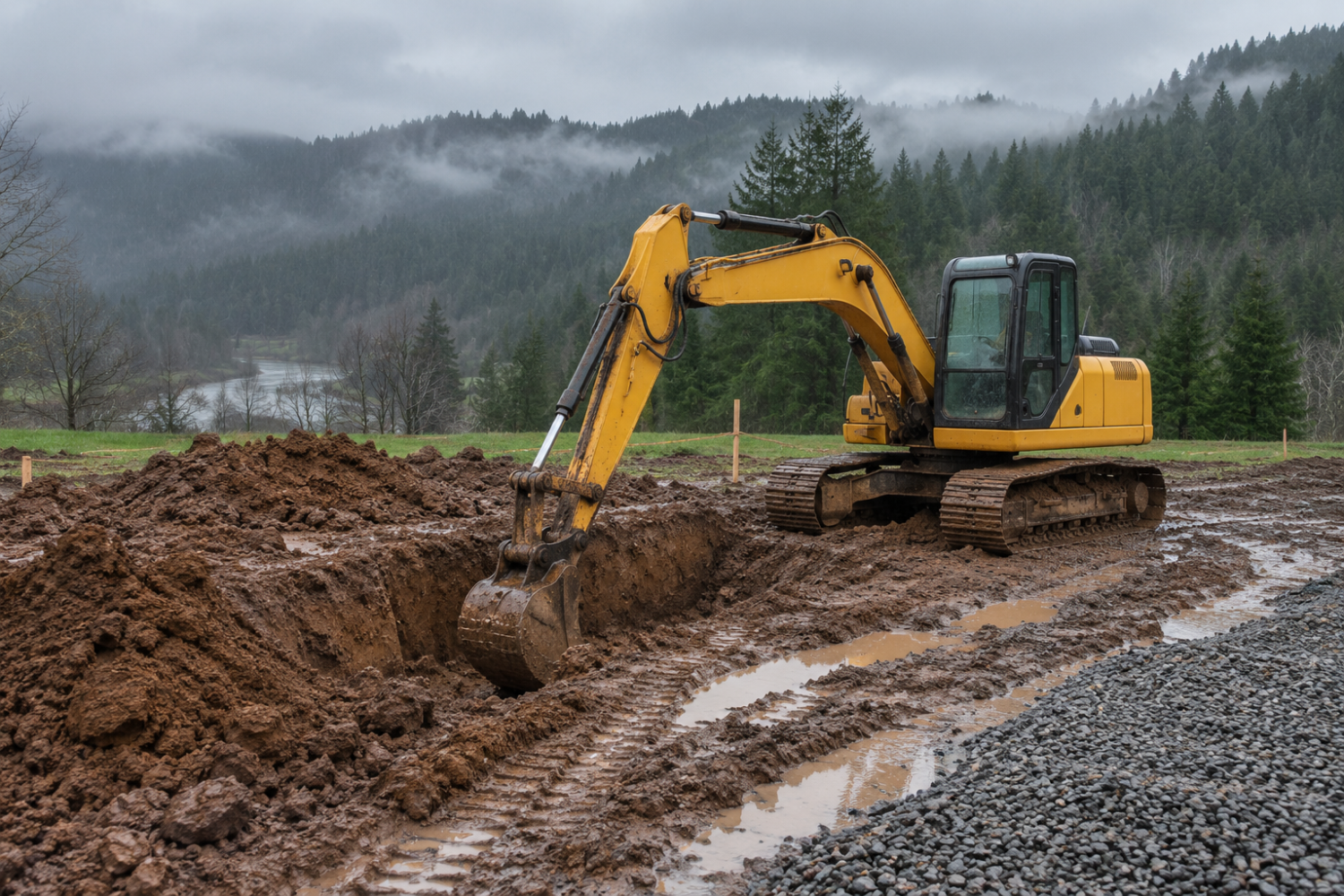
Every November the calls change. People who were ready to start a shop pad, a driveway or a water line in the summer start asking a different question: can you even dig in this, or should we wait until spring?
It is a fair question. You watch the rain come sideways off the hills and picture an excavator sunk to its tracks. The honest answer is that any project can be done through the wet season. Some stages have to wait for dry weather, sometimes a couple of days and sometimes a week or so. What decides how a winter job runs is the ground under your project, how much dirt has to move, and how we keep the mud on your site instead of in the road.
How wet it actually gets here
Longview averages 48.12 inches of precipitation a year, and about 73 percent of it falls between October and March, according to NOAA's 1991 to 2020 climate normals. November and December are the wettest months, at 7.24 and 7.14 inches. December averages 24.3 days with measurable rain, and January 23.9.
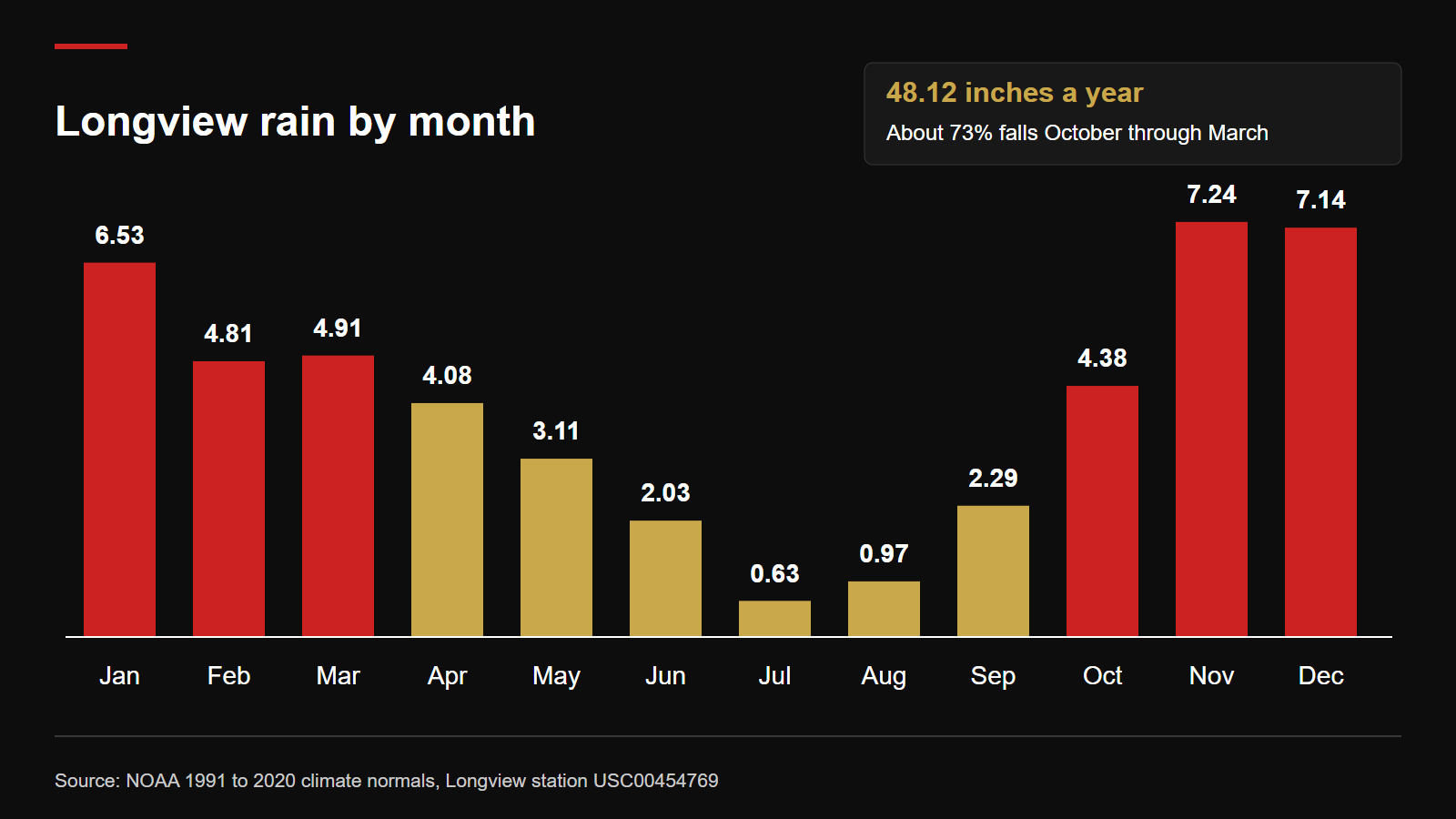
So waiting for a dry month is wishful thinking, but a dry couple of days does come along. We plan the stages that need dry ground around those windows. Cold is rarely the problem here. Water is.
Your ground matters more than the weather
The same storm does very different things to different ground in this county.
Downtown Kelso and much of Longview sit on river alluvium. The soil mapped there, Caples silty clay loam, is described by the USDA Natural Resources Conservation Service (NRCS) as somewhat poorly drained, with slow permeability and a seasonal high water table 1.5 to 2.5 feet below the surface from November to April. Dig a footing or a trench in that ground this time of year and you may hit water before you hit the bottom of the hole.
The hills around Castle Rock are mostly silt loam soils weathered from basalt and volcanic ash, and NRCS describes the main upland soils there as well drained. The flats in Castle Rock itself are river alluvium again, so the address matters, not just the town name.
There is also a limit to what wet soil can do once it has been dug up. WSDOT's geotechnical design manual says that in western Washington, soil "more than a few percentage points over optimum moisture content is often impractical to aerate and dry back." It treats soil as moisture sensitive once it is more than about 10 percent fines, and it says common and select borrow "are not usable as an all weather material," while gravel borrow is.
In plain terms: wet silty soil dug out in December usually cannot go back in and compact the way it would in August. That is why winter work leans on rock. (More on rock bases in How Thick Should Your Driveway Base Really Be?)
It is also why we tell anyone buying land or a home here the same thing: before you buy, have an excavation contractor look at the property. We recommend it anywhere in Cowlitz County, and really anywhere in the Pacific Northwest. Whether a lot sits on wet river-bottom ground or well-drained hillside changes what it costs to build on, and a listing will not tell you which one you are getting.
What we build through the winter
Home site foundations. We excavate foundations in winter. The key is being smart about moving that mass of dirt, following best management practices for erosion and sediment, and assuming a big rain can come at any time.
Pole barn pads, new roads and driveway repairs. These can generally be built in winter when there is not too much material to move and the equipment can stay on rock.
Utility trenching for water, power and drainage lines, backfilled with rock where the native soil is too wet to reuse.
Land clearing. Winter is a really good time to pull stumps and burn or grind them. We come back in spring to grade. Our post Clearing Land in Winter has more.
Planning: permits, locates and design work that has to happen before any spring start.
One rule runs through all of it. If we start churning mud and it starts raining halfway through the day, we pull off the job. Working it makes the ground worse and slower to dry out. A couple of days of good weather or high winds, and we go back.
Every job also starts with a locate. Washington's dig law requires notice to the 811 locator service at least 2 full business days and no more than 10 full business days before digging. Since January 1, 2026, the excavator also needs a positive response from every utility with lines in the area before breaking ground. That duty sits with the excavator, so on our jobs it is ours.
What waits for a dry spell
Fine grading and compacting native soil. If the soil is too wet to compact, rolling it harder just makes mud.
Big dirt moves. We avoid moving large amounts of native dirt in winter when we can, for the moisture reasons above.
Topsoil, final grade and seeding. We supply topsoil spring through fall, when the ground is workable.
None of this is a county calendar rule; Cowlitz County's grading code has no wet-season date restriction. The limits come from the ground and from the state stormwater rules below, and we plan our site grading around both.
Keeping the mud on your site
For permitted grading in unincorporated Cowlitz County, the grading code requires erosion control to be installed before grading starts and says no sediment may leave the site or enter surface waters or wetlands.
Bigger jobs carry state rules too. Ecology's Construction Stormwater General Permit covers soil disturbance of 1 acre or more that drains to surface waters. West of the Cascades, those sites cannot leave soil exposed and unworked for more than 2 days in the wet season, October 1 to April 30, compared with 7 days from May 1 to September 30. Under the permit that took effect January 1, 2026, every permitted site needs inspections by a Certified Erosion and Sediment Control Lead (CESCL), whatever its size.
A certified erosion control lead is often required in the Northwest, and certain counties and cities require one on a project to watch the best management practices. It is a good certification to have on any winter job.
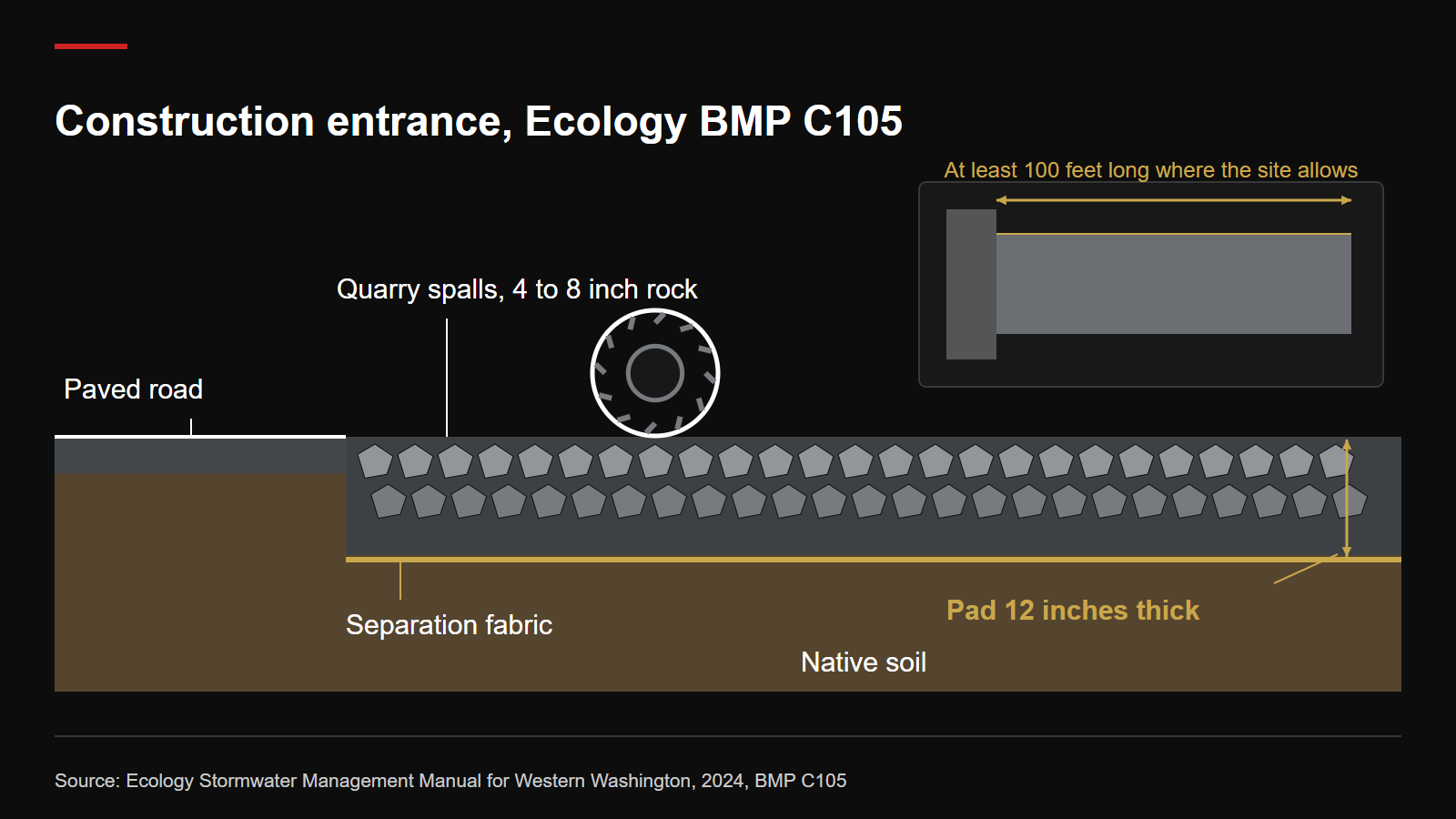
The simplest piece is the construction entrance. Ecology's standard stabilized entrance, known as BMP C105, is a 12-inch-thick pad of 4- to 8-inch quarry spalls over a separation fabric, at least 100 feet long where the site has room. The fabric keeps fine soil from pumping up into the rock, and the rock knocks mud off tires before trucks reach the road.
Questions we hear this time of year
Can you dig footings in the rain?
Usually, yes. The key is keeping water out of the hole and getting the footing in before the bottom turns soft. On river-bottom ground with a high winter water table, that can mean pumping. Footing requirements come from your building permit, so check with Cowlitz County Building and Planning or your city.
Can you compact gravel in the rain?
Clean crushed rock is far more forgiving in the rain than native soil, which is why winter pads and driveways lean on rock. Wet silty soil is the material that will not compact, not the gravel on top of it.
Can you dig in frozen ground?
Longview's average January low is 35.1 degrees, and Cowlitz County's building code uses a 12-inch frost depth for footings. Frozen ground is the exception here. Water is the usual problem.
Should I wait until spring?
Usually not. Any project can run through the wet season, with some stages waiting a couple of days to a week for dry weather. Fine grading, topsoil and landscaping go better spring through fall.
Plan for the water, and the work holds
Winter work done right is work planned around water: the right material for wet ground, equipment kept on rock, mud kept on your site, and a crew ready for the next big rain. Our excavation crew works across Cowlitz County, from Castle Rock to Woodland.
If you are deciding whether to start now or wait, we will look at your ground and give you a straight answer. Request an estimate at columbiagroundwork.com/get-an-estimate or call (360) 957-8847.